

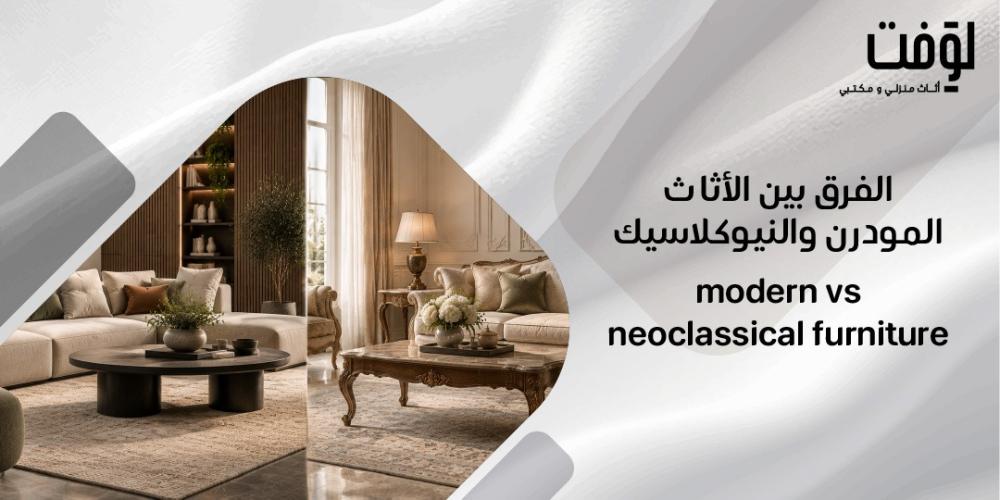
When facing the decision of furnishing your home, you often find yourself choosing between two options that occupy the minds of many refined design enthusiasts: simple modern furniture that speaks the language of clean lines, or the Neoclassical style that carries the spirit of classic elegance without its heaviness. The difference between modern and neoclassical furniture does not stop at appearance alone; it extends to embrace your home’s space, your daily usage patterns, ease of coordination with other decor elements, as well as your available budget. Modern furniture gives you visual lightness and practical arrangement, while Neoclassical elevates the space with subdued ornamentation and richer details without falling into the trap of traditional classic opulence.
Uncertainty when selecting a style for your living room or dining area is completely understandable, as each approach has its own logic regarding materials, colors, suitable spatial requirements, and styling techniques. Therefore, this article provides you with a comprehensive, practical comparison between both styles to help you make an informed decision tailored to your home decor and lifestyle. Once you are ready to choose, the Loft store offers a wide collection of quietly luxurious neoclassical pieces alongside contemporary modern designs, making it easy to find the ideal furniture that harmonizes with your home.
Understanding the Identity of Each Style
Before selecting any major furniture piece—such as a sofa or dining table—it is worth pausing to clearly understand the identity of each style. The piece you select does not merely fill a void; it establishes the visual tone for the entire room. At Loft, you will find designs from both styles crafted to suit diverse tastes with long-lasting quality.
1. Features of Modern Furniture
At its core, modern furniture relies on a philosophy of simplicity and functionality. Its lines are straight or clearly geometric, and its surfaces are clean and free of intricate embellishments. The number of pieces is intentionally kept minimal because negative space is treated as an active design element rather than an empty void to be filled. Its materials rely on contemporary options such as polished metal, glass, and engineered or solid woods in natural or matte finishes—imparting a calm, contemporary ambiance free from visual weight.
2. Features of Neoclassical Furniture
The Neoclassical style does not follow a single rigid path; rather, it bridges two worlds. It borrows elegance, symmetry, and thoughtful detail from classic design, while taking lightness, simplicity, and freedom from decorative clutter from modern design. Moderate luxury is the most precise phrase to describe it: details manifest through gently carved edges or distinctive button-tufted upholstery without overwhelming the scene or making the room feel congested.
The difference between modern and neoclassical furniture extends beyond the shape of an isolated piece to encompass how furniture is distributed within a space, the lighting used, the selection of accessories, and how negative space surrounding each item is managed. Combined, these elements form the final character of the room.
Key Differences: Design and Materials
When examining a furniture piece to determine its style, the fine details settle the question. Understanding subtle distinctions in lines, colors, and raw materials prevents mixing styles haphazardly and ensures true visual harmony.
1. Lines and Ornamentation
The silhouette a piece casts reveals its origin instantly. Modern furniture builds its identity on clean, straight lines and strict geometric shapes, where ornamentation is virtually absent or limited to very subtle geometric details. Neoclassical furniture does not reject ornamentation; instead, it exercises restraint through graceful curves, soft carvings, and subtle framed edges that never feel heavy or exaggerated. While modern surfaces are predominantly smooth and plain, neoclassical ornaments remain organized and calculated.
2. Color and Texture
While both styles lean on calm neutral palettes, their application differs significantly. Modern design favors color clarity with fewer tonal gradations, delivering visual crispness and calm simplicity. Neoclassical design embraces a warmer palette—welcoming beige, cream, and warm gray—complemented by the natural warmth of wood and restrained metal accents in gold or bronze. Additionally, neoclassical fabric textures are generally richer and heavier compared to practical modern textiles.
3. Materials and Hardware
Modern furniture exhibits great flexibility in material selection—incorporating metal, glass, engineered wood, or smooth wood finishes, frequently featuring slim metal legs and elevated bases that convey visual weightlessness. Neoclassical design grants natural wood a more prominent and deeper role, often combining it with rich upholstery, resulting in a balanced, grounded stance with elegant details.
Advantages and Limitations of Each Style
A meaningful comparison between two styles does not end with declaring a winner; rather, it requires evaluating what each style offers and the structural conditions it demands.
1. Modern Furniture: Strengths & Challenges
- Strengths:
- Practical simplicity makes modern pieces easier to integrate with contemporary appliances and accessories without complex coordination.
- Visual airiness creates an illusion of spaciousness, making it ideal for small to medium apartments.
- Allows building a cohesive decor without needing numerous supporting pieces.
- Individual pieces can be easily updated or swapped without disrupting the overall room harmony.
- Challenges:
- Over-minimizing detail can cause a room to feel sterile or cold if not balanced with textured rugs, ambient lighting, or warm materials.
- Ultra-slim frames may lack the substantial visual presence preferred by those who favor rich decor.
2. Neoclassical Furniture: Strengths & Challenges
- Strengths:
- Delivers moderate luxury and balanced symmetry that remains sophisticated and timeless.
- Blends effortlessly with layered drapery, architectural moldings, and statement lighting to build a complete decor theme.
- Thrives in larger living rooms and open-plan spaces where intricate details have room to breathe.
- Reflects refined taste without requiring oversized or heavily decorated items.
- Challenges:
- Requires precise styling; without thoughtful coordination, the space can quickly feel visually cluttered.
- Needs supporting elements—such as consoles, mirrors, side tables, and tailored lighting—to fully express its intended aesthetic.
Spatial Considerations and Daily Use
Furniture choice must extend beyond aesthetics to consider room dimensions, traffic flow, and household use.
1. Small to Medium Apartments
Modern furniture is exceptionally suited for tight footprints, as keeping piece counts low and lines clean preserves open floor space, while integrated storage units offer practical solutions. On the other hand, Neoclassical design does not automatically cause overcrowding, but it requires comfortable movement clearance to display its symmetry properly. If applied in smaller spaces, the solution is to minimize the number of pieces and decorative details.
Practical tips for smaller spaces:
- Measure sofa and table dimensions before buying to ensure sufficient walking clearance.
- Choose elevated, high-legged pieces when selecting modern items to enhance the sense of space.
- Limit neoclassical items to two or three accent pieces per small room instead of filling every corner.
2. Open-Plan Living Rooms
Open-plan layouts allow both styles to express their full potential, though each handles space differently. Neoclassical furniture shines in larger areas where balanced details require viewing distance to be appreciated without feeling crowded. Modern furniture in large rooms requires conscious visual anchoring (such as area rugs or central lighting fixtures) to prevent minimal pieces from appearing scattered.
Practical tips for open-plan spaces:
- For Neoclassical style, arrange seating symmetrically around the center of the hall while maintaining visual balance from every angle.
- For Modern style, define seating areas using central rugs or dedicated light fixtures to give large open spaces clear visual organization.
- In both cases, maintaining comfortable, wide walkways between furniture groups is essential.
3. Living Room and Dining Room
In the living room, Modern style materializes through straight-lined sofas, minimalist coffee tables, and unpretentious lighting, whereas Neoclassical style appears through balanced sofas with warm textures and understated decorative mirrors or lamps. In the dining area, an acacia wooden table with clean lines and dark legs creates a modern direction, which gradually shifts toward Neoclassical when paired with tailored upholstered chairs, warmer textiles, and classic lighting accents.
Featured Picks from Loft
The Loft collection features carefully selected pieces that combine function with design. Whether you are furnishing a family living area or a reception room, these selections represent the best of modern living.
1. THE KEY Modern 3-Seater Fabric Sofa
The THE KEY 3-Seater Fabric Sofa exemplifies the balance between modern simplicity and everyday comfort. Built with clean straight lines and sturdy metallic legs, it stands as a signature piece of modern design.
- Comes in a neutral beige fabric that pairs easily with various wall palettes and accent accessories.
- Measures 300 cm (L) × 97 cm (W) × 91 cm (H), comfortably seating three adults.
- Features high-grade, wear-resistant upholstery supported by a stable metallic frame built for daily stability.
- Includes supportive back cushions tailored for long conversations or relaxing evenings.
2. Acacia Solid Wood Dining Table
For those seeking to introduce the natural warmth of solid timber into a sleek contemporary space, the Acacia Dining Table offers a compelling option. It bridges natural texture with structural modernism by combining a polished solid wood top with clean black legs.
- Measures 240 cm (L) × 120 cm (W) × 75 cm (H) in a rich Nocci finish, providing a spacious surface for family meals and gatherings.
- Solid wood construction ensures structural stability, color retention, and long-term durability.
- Complements dining areas looking for a modern wooden table built from robust natural materials.
Frequently Asked Questions (FAQ)
1. What is the difference between Modern and Classic furniture?
Modern furniture focuses on functional minimalism, clean lines, and contemporary materials, whereas Classic furniture relies on heavy ornamentation, rich carvings, symmetrical arrangements, and darker woods. Neoclassical sits between the two—retaining classic elegance through a lighter, updated design language.
2. What are the common types of Modern furniture?
Common types include track-arm sofas, modular sectionals, geometric coffee tables, floating wall units, and minimalist dining sets featuring metal, glass, and smooth wood finishes.
3. What defines Classic furniture?
Classic furniture is defined by rich wood carvings, ornate detailing, heavy fabrics (such as velvet or brocade), deep color tones, and formal, symmetrical layouts.
4. How do I choose the best furniture style for my home?
Base your choice on available floor space, daily routine, personal preference, and budget. Modern style suits those prioritizing practical spatial efficiency, while Neoclassical suits those seeking quiet elegance. Prioritize build quality and proper scale above all else.
Conclusion
The difference between modern and neoclassical furniture centers on core design priorities: Modern design prioritizes functional simplicity, geometric lines, and visual lightness, whereas Neoclassical design emphasizes warmth, refined symmetry, and quiet opulence.
Ultimately, your choice should align with your floor plan, routine, and personal taste. Remember that creating balanced harmony between individual pieces matters far more than adhering rigidly to a single style definition.
Whether you are looking for living room sofas or dining tables, explore the curated furniture collections at the Loft store to find the perfect pieces for your home.